看书学英语
Learn English from Books

The Craft of Visual Storytelling
Every story introduces characters and situations, reveals backstory, creates problems and conflicts for the characters, and then shows how the characters deal with them.
Good writing and performances are essential ingredients of a compelling movie, but the story will fall short of its potential if the visual storytelling is not well designed. This is because films are primarily stories told in pictures: even with the sound turned off, a movie’s images usually make it fairly clear what’s going on.
jrhz.infoA large part of a director’s job is to use visual storytelling techniques to present story information visually and to manipulate viewers’ thoughts and emotions using visual means. Every action shown in a film can convey a range of meanings and elicit a range of emotions depending on how it is shot and edited. For example, a character walking down a street can be shot to seem either safe or threatened simply by changing the camera’s angles and motion. Some of these film techniques are obvious, such as the dramatic effect of a close-up, while others are more subtle. Every director must learn the full range of these techniques to master the craft of visual storytelling.
Writing, acting, cinematography, and editing are interdependent. A filmmaker ties these elements together. A director is responsible for the “big picture” view of the storytelling that spans every shot and every scene. Experienced directors have a storytelling plan in mind that is both broad and detailed, and it guides them in the design of virtually every shot and cut.
Camera Positions Make a Dramatic Difference
Directors must spend time brainstorming how best to bring scenes to life. What they’re doing is imagining how the action should be staged, what the camera angles and shot sizes should be, and how the pieces of several shots will be cut together. A director’s early consideration of staging and shooting requirements for the ideal storytelling of a scene can greatly assist the locations manager in finding suitable locations. Once locations have been found a director will spend time imagining where the action will take place and where the camera should be positioned to best tell the story.
To illustrate the importance of camera placement, let’s imagine several ways to begin a scene in which a prisoner is alone in a prison cell. We’ll look at several ways the camera can be positioned and moved, and consider the storytelling effect of each.
Where do we place the camera? A natural starting point is to use a wide shot. In a prison this probably means placing the camera in the hallway (Figure 0.3). This is an establishing shot, and it introduces the setting of the scene and places the prisoner in context. This shot is very deive of the setting but says little about the prisoner.

It does not cause viewers to feel much empathy or curiosity about the prisoner. Our wide shot is a little boring because nothing in the shot is moving, and in such cases the camera is often moved slowly sideways to create visual interest from the camera’s changing perspective. Such camera movement will also create a feeling of suspense.
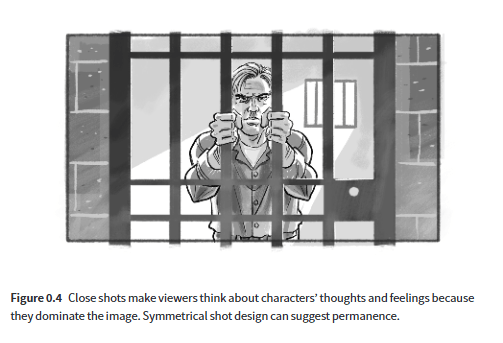
Suppose our scene starts instead with a close shot of the prisoner as seen from the hallway (Figure 0.4). We see him in more detail and with fewer distractions, and we start to infer things about his character as we get to know him. But the bars between us emphasize the fact that he’s a prisoner: we feel some psychological distance from him because we are outside the cell, while he’s inside. If we choose this shot to begin our scene instead of a wide shot, we sacrifice the details of the setting, the spatial depth of the hallway, and the mood of the jail. Note that this shot has a symmetrical composition, which typically suggests permanence, and may be fitting because it suggests that the prisoner will not be free any time soon.
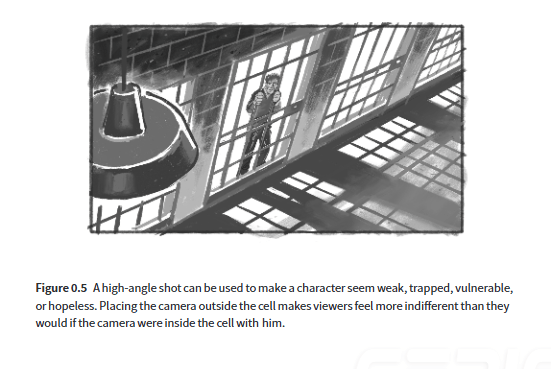
A high-angle shot of the prisoner as he stands behind the bars makes him seem hopeless (Figure 0.5). High-angle shots are often used to make a character seem weak, helpless, confused, or lost. By keeping the camera outside the prisoner’s cell for this shot, the director makes viewers feel more detachment than they would if the camera were in the cell with him. If the prisoner is shown holding the bars in a low-angle shot, we feel that he is defiant. Low-angle shots are often used to make a character seem stronger (Figure 0.6).

A low-angle shot such as this starts our scene dramatically. One common reason to begin a scene with a close shot of a character is to create a story link to the character we’ve cut from. Depending on what took place in the preceding scene, viewers will interpret this visual link as one character thinking about, being oblivious to, or deceiving the other.
Another option is to start our scene with a slow panning shot that scans across some items in the cell that say something about the character (Figure 0.7). Does the cell look lived in, with photos taped to the wall and a collection of books? Are the days recorded as scratches on the wall? By the time the pan finds the prisoner, viewers already know something about his life. Starting a scene in a new setting without a character in the shot, and panning to find the character, is a commonly used transition to a new scene. The choice of placing the camera in the cell with the prisoner makes the storytelling more subjective. Viewers empathize with the prisoner because we feel that we are in this cell too.
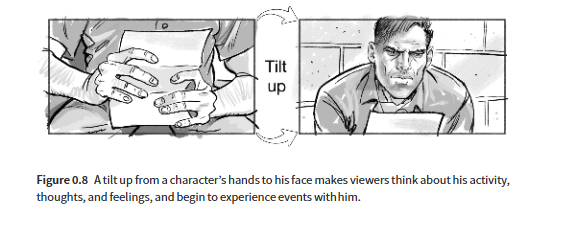
Our scene could begin close on the prisoner’s hands: perhaps he is holding a letter or his dinner tray (Figure 0.8). The shot now tilts up to the prisoner’s face. If he’s eating, the tilt could follow his spoon upward. Such shots create empathy in viewers because they are close to the character, they emphasize what the character is doing, and they exclude distractions.
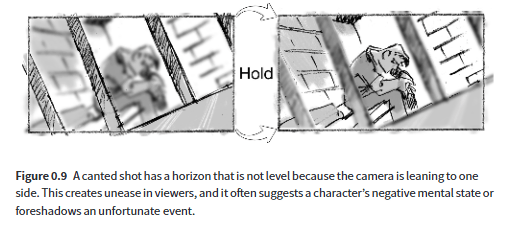
Another idea for starting this scene is to begin with a shot that is angled so that the horizon is not level: this is a canted shot. Canted shots make viewers feel uneasy, and this feeling is projected into the character as psychological tension. Here it suggests that the prisoner’s mental state is boredom, anger, or frustration. The effect of the cant can be heightened by combining it with a focus change (Figure 0.9). The shot begins with the bars in focus and the prisoner blurry, and as the prisoner is brought into focus the bars become blurry. We are made to feel that time is moving slowly in this prison cell.
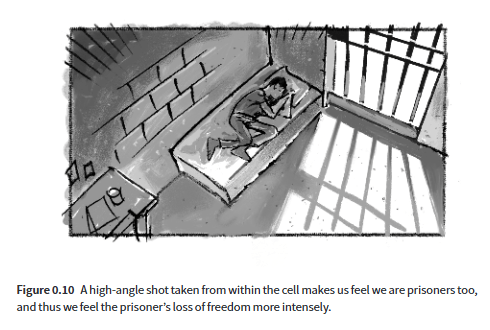
Another approach to beginning our scene is to use a high-angle shot taken from within the prisoner’s cell. This makes him seem caged and his situation seem hopeless (Figure 0.10). Because we are also in the cell we share his despair. A cut to a closer shot at or just below the prisoner’s eye level would take us further into his thoughts and feelings.

Our scene could begin with an intense close-up of the prisoner. If we already know he’s in prison from an earlier scene, a close-up will make us project our own thoughts and feelings about imprisonment into him, even if his expression is neutral (Figure 0.11). If we don’t yet know where he is we may be surprised when the second shot of the scene shows us, or when the camera pulls out to reveal where he is. This may be done to surprise viewers for either a comedic or dramatic reason. Any close-up can be intensified by slowly pushing the camera closer. This makes viewers feel what a character is experiencing even more deeply.
These examples of various ways to start a prison scene illustrate the storytelling potential that is available simply from choosing where to place the camera. Naturally there are further shot possibilities beyond the ones illustrated. For example, we could tilt down from the ceiling to find the prisoner. Or tilt up from his feet. Or dolly side-ways in the hallway close to the bars so they cross the screen until the camera finds the prisoner. The scene could begin with a montage of images such as a dirty dripping tap, the photos on the wall, the barred window, or a fly crawling on a dirty dish.
These shots could be followed by a wide shot of the prisoner. The prisoner could step into a shot or roll over in his bed to reveal his face. What’s important is to think of a number of possibilities and then choose the ones that seems best for the story, both at each moment and within a sequence of shots.
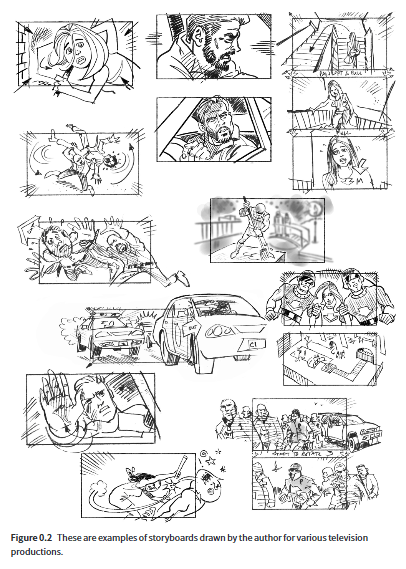
Reading a scene and visualizing possible ways of shooting it can be both fun and challenging. For each idea that you imagine, you must play the role of your film’s first audience. You have to gauge how each proposed sequence of shots affects you, and you can assume that it will have similar effects on viewers. It’s important not to be too critical of your ideas at first or you risk discarding something that might be effective with just a little modification. Once you’ve settled on a plan for the visual storytelling of a scene, it can be saved by using a shot list, by drawing a map, or by creating a simple storyboard. The job of brainstorming and previsualizing shots and sequences is a key part of directing, and it gets easier through practice and by learning more technique.
☑文章来源:
The Art of Cinematic Storytelling
: A Visual Guide to Planning Shots, Cuts, and Transitions
爱学术数据库可全文阅读本书
☑ 编辑:LZC
☑ 审核:CQS
北京电影学院图书馆


