


Nov. 23, 2024 — Wei Dongyi has solved a century-old mathematical problem and received an award.
This trending topic is different from previous ones—not driven by unexpected contrasts, but by genuine, hard-won scientific achievements.
Wei Dongyi has been awarded the 2026 Beijing “Outstanding Youth Zhongguancun Award,” one of the highest honors specifically designated for young scientific researchers.
The award recognizes his collaborative work with fellow researchers in solving a long-standing open problem in fluid dynamics—one that has puzzled the academic community for nearly 140 years.
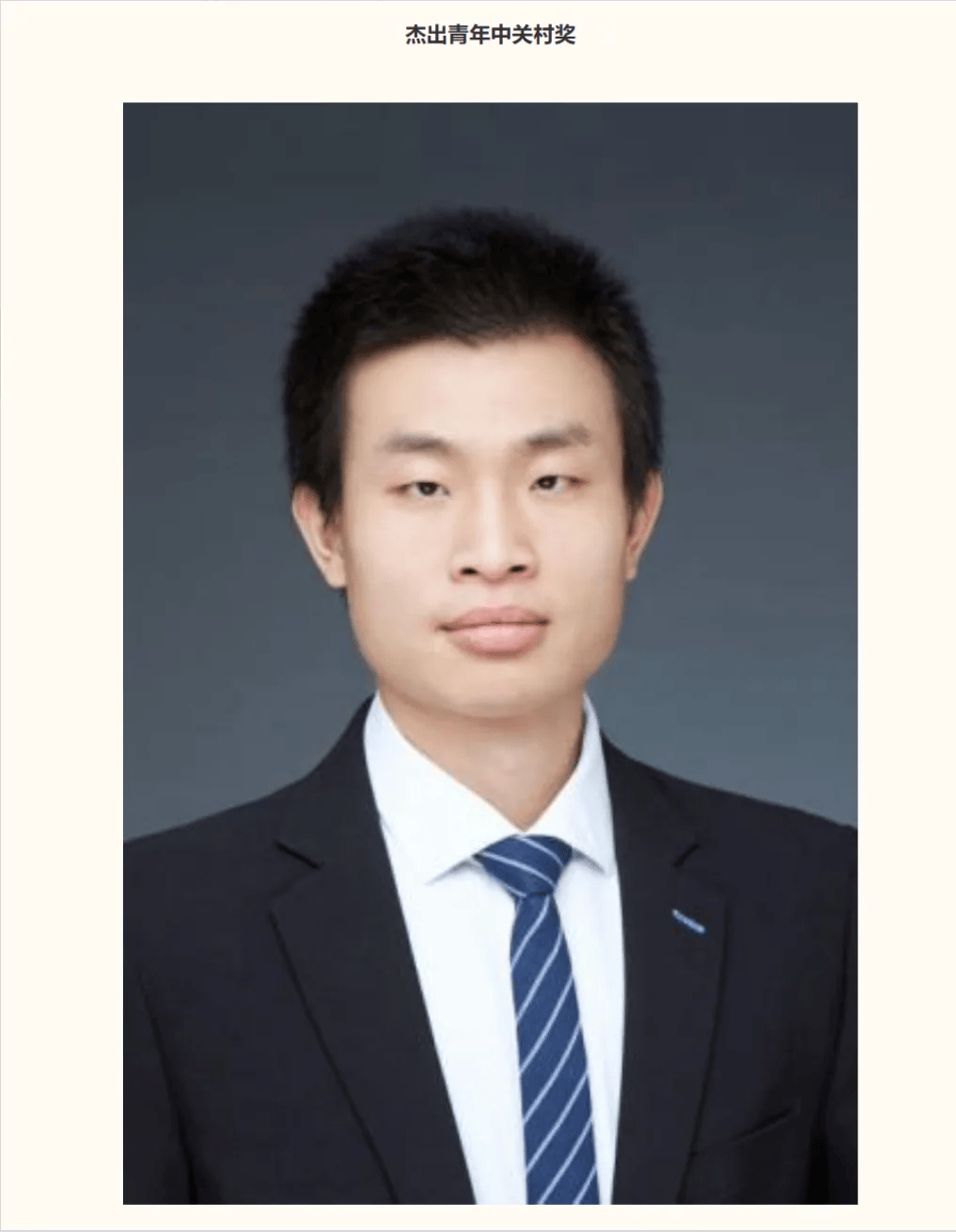
Image source: Screenshot from Weibo
More significantly, this award does not accept self-nominations; candidates must be formally nominated by experts or professional organizations. In Wei Dongyi’s case, he was jointly nominated by two academicians—Wen Lan and Wang Shicheng.
When two academicians jointly vouch for and recommend a researcher in his thirties, their endorsement carries immense weight within the academic community—those familiar with scholarly norms fully understand its significance.
This century-old problem, first posed in the late 19th century, had eluded rigorous mathematical proof for over a hundred years—until Wei Dongyi and his team cracked it. Their breakthrough has broad practical implications: from urban water-pipe system design to high-speed rail aerodynamic drag reduction and aircraft airframe optimization.
Some previously claimed Wei Dongyi could only solve textbook problems—not conduct original research. This award delivers a resounding rebuttal to such misconceptions.
Notably, Wei Dongyi has also made several memorable appearances outside academia in recent years.
The most iconic occurred during a street interview in 2026: he appeared holding a large bottle of mineral water and two plain steamed buns, speaking slowly and modestly, seeming shy and slightly awkward.
Netizens soon uncovered his extraordinary background—he is a legendary figure in Peking University’s Department of Mathematics, having earned perfect scores twice at the International Mathematical Olympiad (IMO), then proceeding directly through undergraduate, master’s, and doctoral programs at PKU, and becoming a faculty member at a remarkably young age.
The striking contrast propelled him to overnight fame across China, earning him nicknames like “God Wei” and “the Broom-Sweeping Monk of Peking University.”
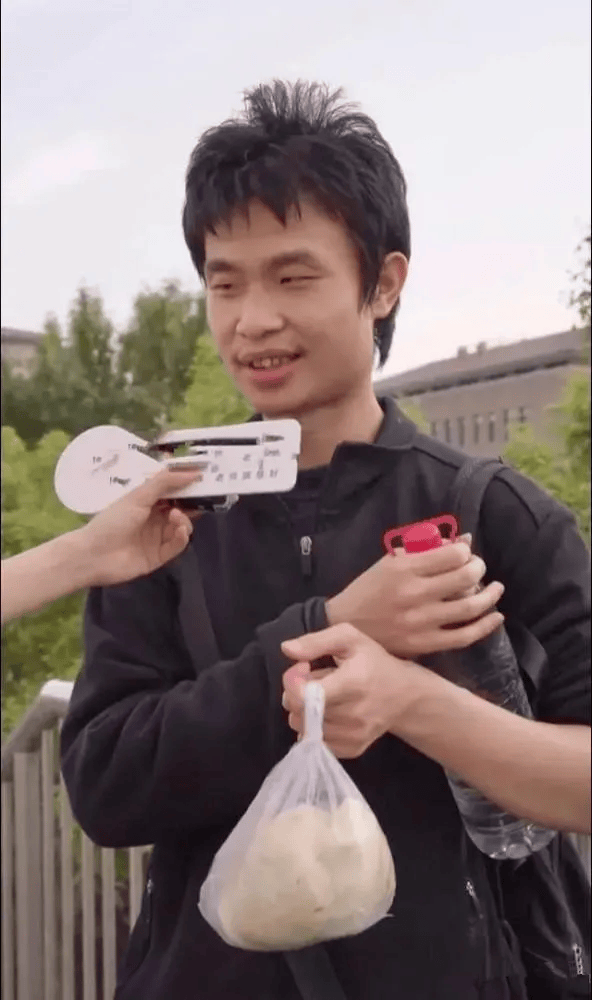
Image source: Weibo
Yet, as his popularity surged, so did controversy. Countless myths and rumors spread online—claims that Harvard University waived its century-old admissions policy to admit him without examination; that six Ph.D.-level researchers spent four months struggling with a problem he solved in a single afternoon.
Imposters even created fake social media accounts bearing his name—amassing millions of followers—while businesses rushed to trademark his name. A dedicated, down-to-earth scholar was effectively reduced to a “traffic magnet,” repeatedly exploited for online attention.
Wei Dongyi himself publicly acknowledged that external public discourse had begun affecting him.
Subsequently, China’s Cyberspace Administration intervened, removing over 5,000 fraudulent accounts impersonating Wei Dongyi—bringing this viral spectacle under partial control.
That said, it’s worth noting that in 2026, Wei Dongyi joined Douyin (TikTok’s Chinese counterpart). His 4-second self-introduction video gained nearly 20 million followers within days.
Yet again, public attention veered off course—focusing instead on his missing tooth and speculating about when he might find a romantic partner.
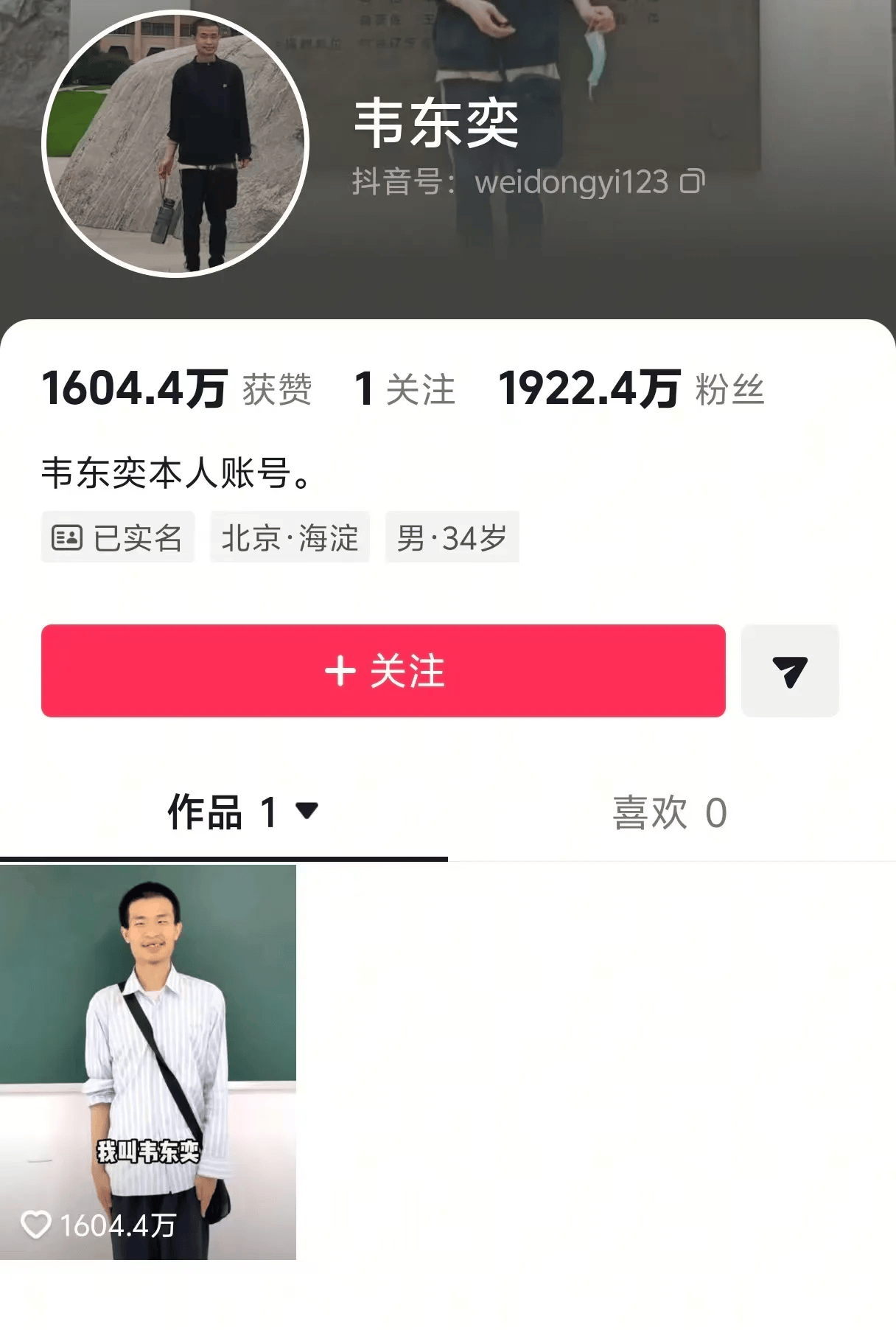
Image source: Douyin
At the time, LeiTech found it deeply ironic: a world-class mathematical researcher was most widely discussed not for his intellectual contributions—but for his appearance and mundane personal details.
This time, however, his award-winning achievement generated no memes or jokes. Instead, netizens engaged earnestly with his scientific work—comments were uniformly respectful and reverent.
LeiTech’s official account (ID: xiaoleibbb) believes this is precisely how it should be: when discussing a scholar, our ultimate focus ought to rest on their research accomplishments—not on internet memes derived from their private lives.
To be fair, the “deification” of Wei Dongyi isn’t entirely baseless. First, the contrast is extraordinary: he minimizes material needs to the barest essentials, channeling all his energy into mathematics—perfectly embodying popular archetypes of reclusive sages or “broom-sweeping monks.”
Second, despite commanding top-tier online visibility, he deliberately avoids leveraging it—his purity of purpose and unwavering focus are exceedingly rare. Add to that his status as an academic prodigy who has just conquered a century-old challenge—and the awe becomes entirely understandable.

评论 (0)
登录后参与评论